Sun 8 Apr 2012
Categories : Thoughts / Lessons
Comments (3)
Sun 8 Apr 2012


 Positive facts which people / world doesn't know much about Pakistan, other than doing and having just negative thoughts and critisism.

Of all the countries in the world

  • Pakistan is the second largest exporter of clothing
  • Fourth largest cotton producer
  • Fifth largest milk producer
  • Pakistan is only Muslim nuclear power as well as a declared nuclear weapons state
  • Tenth largest workforce in the world
  • Seventh largest pool of scientists and engineers in the world
  • 28th largest economy in the world worth $1 trillion (Dh3 trillion)
  • Stands at number two in terms of per capita charity donations after the US.
  • Pakistany has the fifth largest coal, copper and gold reserves in the world worth $65 billion
  • Pakistan Stock exchange was the world's third best performing last year despite all the troubles.
  • Pakistan has the seventh largest standing armed forces in the world
  • Pakistan has the second largest Muslim population in the world. It is second to Indonesia
  • The worlds second and ninth highest mountains , The K2 and Nanga-parbat, are in Pakistan
  • Pakistan has best weather for business in the world, ccording to GALLOP survey from whole world.
  • Pakistan is 2nd in Entrepreneurial activities in Asia after Japan
  • Best performance at Field hockey World Cup (men)
  • Most number of British Open Squash champions (men)
  • Greatest number of World Open Squash champions (men)
  • Most successful team in ICC World Twenty20 Cup
  • Highest paved international road, Karakoram Highway at 4,693 m (15,397 ft)


Proud to be a Pakistani. Long live Pakistan because Pakistan Best. Ooopss after reading these...Is something burning????


Categories : Knowledge / Amazing
Comments here
Fri 14 Aug 2009

PakistanFlagButterfly.jpg


Pakistanflag_afp_766.jpg

Categories : Knowledge / Amazing
Comments (3)
Mon 1 Dec 2008

HAARP - More than 200 miles east of Anchorage, Alaska, is the Pentagon's High-frequency Active Auroral Research Program, officially an enormous experiment to heat the ionosphere with radio waves. But conspiracy theorists believe the project is a weapon to bring down aircraft and missiles by lifting sections of the atmosphere, cause earthquakes or even a huge weather modification machine.

Source - telegraph.co.uk

haarp_1116124i.jpg

Categories : Knowledge / Amazing
Comments here
Wed 15 Oct 2008

A safety device which prevents drivers using mobile phones by automatically intercepting calls and text messages when they are moving has been unveiled.

The software tells callers the person they are trying to reach is driving and asks them to leave a message.

   Software blocks car phone users _45107516_driver-on-phone-226b.jpg
   
 start_quote_rb.gif Our advice to drivers is to switch off their mobile phones... and let voicemail do its job end_quote_rb.gif
The Royal Society for the Prevention of Accidents

Canadian firm Aegis Mobility hopes its system will become available via a monthly subscription fee.

The Royal Society for the Prevention of Accidents (RoSPA) says drivers are four times as likely to crash using a phone.

Phone fine

The DriveAssist system can also tell callers where the person they are trying to reach is located by using satellite navigation technology.

Motorists using mobile phones caused 25 fatal, 64 serious and 259 slight accidents in 2007, according to the Department for Transport.

It has been illegal to use a mobile phone while driving since December 2003 - with offenders facing a £60 on-the-spot fine and three points on their licence.

A RoSPA spokesperson told BBC News: "Our advice to drivers is to switch off their mobile phones when they get behind the wheel and let voicemail do its job."

Meanwhile, a survey by motoring group RAC shows almost half of drivers are seriously distracted by in-car technology - rising to 55% for 17-to-24-year-olds.

The most distracting gadgets were radios and CDs, followed by mobile phones and satnav systems which each put off around a third of drivers.

Heating and air conditioning controls distracted 35% in the survey of 1,034 motorists.

Anti-locking brake systems (ABS) and immobilisers are fitted as standard on new cars, yet only 70% of drivers knew they had ABS and only 68% knew they had immobilisers.

The Department for Transport says distractions account for 12% of all road accidents. In 2007 that amounted to 75 fatal, 411 serious and 2,517 slight accidents.

The RAC survey also looked to the next 20 years of motoring and revealed:

 • 23% believe drivers will be able to simply input an end destination then sit back and enjoy the ride.

 • 35% think cars will be able to "talk" to each other to pinpoint and avoid traffic.

 • 71% believe cars will be able to tell you when you are exceeding the speed limit with half predicting automatic prevention.

 • 60% predict fingerprint, voice or breath recognition will replace keys to start a car.

 RAC's technical director David Bizley said: "In-car technology has come a long way since the late 80s. The advances have fallen into two camps - active and passive.

"Active technologies such as in-car entertainment are not always positive as they can cause driver distraction, while passive technologies, such as anti-locking brake systems (ABS), are undervalued as they are not fully understood or deemed less important as they come on automatically."

 Reference: news.bbc.co.uk/2/hi/technology/7669533.stm

Comments here
Thu 22 May 2008

By Jane Wakefield
Technology reporter, BBC News


Plans for a super-database containing the details of all phone calls and e-mails sent in the UK have been heavily criticised by experts.


The government is considering the changes as part of its ongoing fight against serious crime and terrorism.

Assistant Information Commissioner Jonathan Bamford has warned that the UK could be "sleepwalking into a surveillance society".

Others have questioned how such a database could be made secure.


Public confidence

"While the public is "sleepwalking" into a surveillance society, the government seems to have its eyes wide open although, unfortunately, to everything except security," said Jamie Cowper, data protection expert at data protection firm PGP Corporation.

"The bottom line is - information of this nature should only be held if - and only if - it can be demonstrated that an appropriate system of checks and balances is in place and the security of the information being stored is of paramount concern," he added.

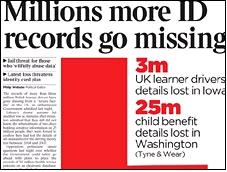
Public confidence in the governments' ability to look after data has been dented in recent months with high profile failures, including the loss of a CD carrying all the personal details of every child benefit claimant.


The latest plans being mulled by the Home Office will form part of the proposed Communications Bill, which is due to be considered by MPs later this year.

It is, said a Home Office spokesman, crucial "to ensure that public authorities have access to communications data essential for counter-terrorism and investigation of crime purposes."


Risks


The more people who have access to it the more risks there would be

Chris Mayers, Citrix Systems

It would extend the powers of RIPA (the Regulation of Investigatory Powers Act) which currently allows hundreds of government agencies access to communications data.

Some believe such legislation, which requires government authorities to request information from communication providers, is more than adequate for law enforcement purposes.

"The fight against terrorism doesn't require a centralised database," said Chris Mayers, chief security architect at Citrix Systems, an applications delivery firm.

"Such a database would face threats from both outside and inside. The more people who have access to it the more risks there would be," he said.


Big Brother

The Internet Service Providers' Association said it was seeking more information about the proposals.

"In particular we want to know more about the Government's intentions regarding "modifying the procedures for acquiring communications data," said a spokesman.

In the run-up to RIPA being approved by parliament, human rights campaigner Privacy International argued that such an act would be a dangerous first step towards a "Big Brother" society.

According to Gus Hosein, a senior fellow at Privacy International, the latest proposals could be even more controversial.

"The idea that ISPs need to collect data and send it en masse to central government is, without doubt, illegal," he said.


uk database.JPG

Categories : Knowledge / Amazing
Comments here
Sun 20 May 2007

[No text] Zimbabwe Inflation.gif

Categories : Knowledge / Amazing
Comments (1)